Edge AI Security
Edge AI changes the trust model because inference happens on devices that are physically reachable, tightly coupled to sensors and sometimes actuators, intermittently connected, power constrained, and often deployed in uncontrolled environments. Security therefore becomes a cross-layer problem spanning firmware, model storage, runtime execution, sensor trust, update integrity, and lightweight hardware-software defenses.
Animated visualization of different types of edge-AI attacks.
Why edge deployment changes the security problem
Edge AI places computation close to the data source. This reduces latency, lowers bandwidth demand, and can improve privacy by avoiding continuous cloud upload. At the same time, it removes the protective assumptions of centralized infrastructure. The device is now in the field, often in homes, factories, vehicles, cameras, gateways, wearables, or mobile robots, where attackers may physically probe the board, tamper with sensors, replace firmware, observe power and timing behavior, or extract model artifacts from local storage.
A useful way to understand edge AI security is to think in terms of four trust boundaries. First is the device boundary: boot state, firmware, credentials, debug interfaces, and physical tamper resistance. Second is the model boundary: confidentiality and integrity of weights, quantized parameters, and runtime execution. Third is the data boundary: the trustworthiness of sensor inputs, local preprocessing, caching, and memory. Fourth is the lifecycle boundary: onboarding, provisioning, attestation, remote updates, and end-of-life handling. A strong edge system must hold across all four.
What counts as edge AI?
- Embedded inference: microcontrollers, NPUs, DSPs, FPGAs, and low-power SoCs running local models.
- Smart sensing systems: cameras, microphones, radar, biosensors, industrial sensors, and multimodal gateways.
- Connected products: IoT nodes, wearables, medical devices, smart-building devices, and consumer electronics.
- Edge gateways: industrial gateways, vehicular units, telecom edge nodes, and local RAG/inference appliances.
- Real-time systems: systems where latency, privacy, or resilience makes cloud-only inference impractical.
Why edge AI security is different from cloud AI security
- Physical access is realistic: the attacker may touch, open, probe, or replace the device.
- Resources are tighter: strong security controls must fit power, area, cost, memory, and latency limits.
- Sensor trust is central: the attack may target the model through the physical world or through local peripherals.
- Offline operation matters: devices may need to make decisions even without continuous cloud supervision.
- Update risk is high: the field lifecycle of secure provisioning, patching, rollback protection, and decommissioning becomes critical.
Core security goals at the edge
- Model integrity: ensure the deployed model and runtime have not been tampered with.
- Model confidentiality: protect valuable weights, embeddings, prompts, and configuration data from extraction.
- Sensor and data trust: ensure local inputs are authentic, bounded, and plausibly consistent.
- Execution trust: verify that only authorized firmware and workloads run on the device.
- Availability and safety: keep the device useful under fault, abuse, intermittent connectivity, and hostile environments.
- Lifecycle assurance: provision, attest, update, and retire devices without breaking security guarantees.
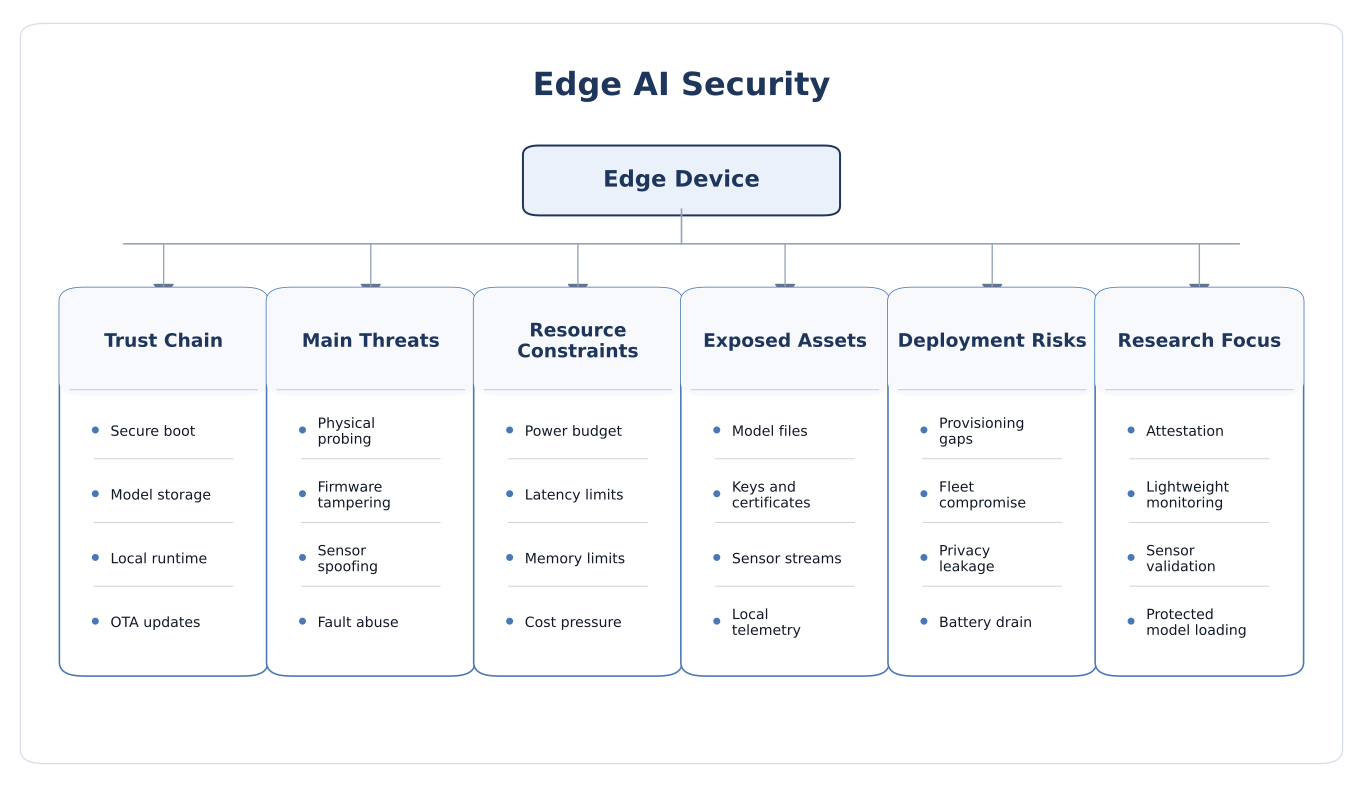
Threat model and edge-specific attack surface
An edge-AI threat model should not begin only from remote APIs. It should begin from what the attacker can do to the device, the firmware, the sensor path, the local model storage, and the runtime execution context. In many deployments, the attacker is local, patient, and adaptive. They may not need to break all protections. It is often enough to exploit one weak interface such as an exposed debug port, a rollback-prone update path, a poorly protected weight file, or an unvalidated sensor channel.
Attacker positions
- Physical attacker: can access the board, enclosure, connectors, storage, or debug interfaces.
- Firmware attacker: can modify boot code, replace images, exploit update logic, or downgrade software.
- Sensor attacker: perturbs the physical input through light, sound, RF, motion, spoofed signals, or injected data streams.
- Local software attacker: compromises the host OS, trusted application boundary, or driver stack around the model runtime.
- Supply-chain attacker: tampers with device components, provisioned credentials, counterfeit parts, or manufacturing-time configuration.
- Remote fleet attacker: exploits onboarding, update orchestration, or management channels to reach many devices at once.
Attacker goals
- Extract: steal model parameters, firmware, credentials, configuration, or local user data.
- Tamper: replace the model, modify thresholds, disable checks, or alter decision logic.
- Evade: cause misclassification, alarm suppression, or false acceptance through local or physical perturbation.
- Persist: implant backdoored firmware, malicious updates, or durable configuration changes.
- Disrupt: induce resets, energy drain, denial of service, or degraded sensing and actuation.
- Scale: use one compromised device or update channel to affect an entire deployment fleet.
Major threat classes
1. Firmware tampering and insecure boot chains
Edge security starts before inference. If boot ROM, first-stage bootloader, firmware image, or model package can be replaced, then many higher-layer defenses become irrelevant. Unsigned updates, incomplete chain-of-trust verification, weak rollback protection, or insecure provisioning can allow adversaries to install modified runtimes, bypass safety checks, or silently downgrade security features.
- Common targets include bootloaders, OTA update agents, configuration partitions, and local model files.
- Downgrade and rollback attacks are especially dangerous in field devices because old but valid images may retain known weaknesses.
- Insecure boot is not only a device problem; it is also a fleet-management problem when update infrastructure is weak.
2. Model extraction and local artifact theft
Unlike cloud-hosted models, edge models are physically present. Quantized weights, compiled binaries, accelerator graphs, tokenizer assets, and runtime metadata may be stored in flash, DRAM, eMMC, or external memory. Attackers may copy these artifacts directly, infer them from side channels, or reconstruct them through firmware analysis. This matters for both commercial IP protection and security, because extracted models enable offline study, transfer attacks, and targeted reverse engineering.
- Extraction can occur through storage reads, board-level probing, debug access, or memory-bus observation.
- Compressed or encrypted storage helps, but only if keys and decryption paths are protected too.
- Model confidentiality is especially important for custom accelerators, proprietary pipelines, and safety-sensitive decision systems.
3. Side-channel leakage and fault injection
Edge devices are ideal targets for physical observation because they are nearby and resource constrained. Power traces, timing behavior, EM emissions, and memory traffic can reveal properties of the model, inputs, control flow, or sensitive operations. Fault injection through voltage glitches, clock glitches, laser/light disturbances, or electromagnetic interference can corrupt runtime execution, skip checks, or induce model errors. In AI systems, these attacks may be used not only to extract secrets, but also to force misclassification or degrade trust.
- Passive leakage: power, EM, timing, cache, bus, and memory-access observation.
- Active faults: voltage, clock, optical, thermal, or EM disturbance to disrupt execution.
- Why edge matters: smaller devices often lack the area and power budget for strong physical countermeasures.
4. Sensor spoofing and physical-world manipulation
Edge AI often sits directly on top of sensors. This means the attacker may never need to touch the weights or firmware if they can reliably manipulate the sensed world. Camera-based systems can be misled by lighting or visual artifacts, microphones by acoustic injection, RF systems by spoofed signals, and industrial sensors by carefully shaped physical disturbances. The attack is partly algorithmic, but the entry point is physical and local.
- Sensor attacks can be transient, stealthy, and hard to replay later in a lab.
- They often exploit preprocessing assumptions before the model even sees the input.
- When the device controls physical actions, the consequence can move quickly from security to safety.
5. Debug-interface abuse and low-level hardware access
JTAG, UART, SWD, test pads, boundary scan, factory modes, and vendor debug paths remain a classic weakness in deployed devices. If these interfaces are left enabled, poorly protected, or recoverable after reset, an attacker may dump memory, bypass boot policy, change configuration, or inspect secure-state transitions. This is a major risk for low-cost edge devices where manufacturing convenience often conflicts with secure deployment.
6. Insecure provisioning, onboarding, and fleet management
Edge devices must be provisioned with identities, keys, certificates, firmware, and sometimes model packages before they can be trusted in the field. Weak onboarding processes allow counterfeit or cloned devices, unauthorized re-enrollment, credential theft, or misbinding of identity to hardware. Once devices are deployed at scale, fleet orchestration itself becomes an attack surface because one compromised management path may affect thousands of nodes.
- Device identity must be rooted in hardware or secure storage, not only in software-configurable values.
- Provisioning and update channels must preserve integrity and authenticity under intermittent connectivity.
- Continuous authorization and lifecycle management matter after onboarding, not only during first boot.
7. Runtime compromise and trusted-application boundary failure
Many edge AI deployments sit inside larger software stacks: Linux gateways, Android devices, RTOS environments, middleware pipelines, and sensor services. A local software compromise can expose model files, capture inputs and outputs, subvert attestation, or manipulate inference scheduling. This means that protecting the NPU or model binary alone is not enough.
8. Privacy leakage through local caching and telemetry
Edge AI is often marketed as privacy-preserving because raw data stays local. That promise is only partially true if the device stores cached inputs, embeddings, feature maps, logs, or telemetry that later leave the device. Sensitive information may leak not only through the inference result, but through diagnostic uploads, crash logs, local storage remnants, or poorly minimized fleet analytics.
9. Resource exhaustion and denial of service
Resource-constrained devices can be pushed into unstable behavior with comparatively small effort. Adversaries may flood inputs, trigger repeated wakeups, induce expensive inference paths, drain batteries, exhaust SRAM, or cause thermal throttling and watchdog resets. These attacks are especially relevant for battery-powered sensors and always-on edge classifiers.
10. Reliability-to-security crossover
At the edge, reliability issues often become security issues. Aging, voltage droop, temperature variation, memory errors, and noisy sensors can interact with adversarial behavior. An attacker may exploit known weak operating regions where the model or hardware becomes easier to fault, less calibrated, or more predictable. This is one reason edge AI security is inseparable from robust hardware-aware design.
Countermeasures and practical design principles
Edge defense is about building a lightweight but trustworthy stack. Unlike datacenter systems, edge devices often cannot afford large software guards, extensive telemetry, or heavy cryptographic overhead on every operation. The strongest designs therefore combine hardware roots of trust, secure lifecycle controls, model-aware runtime protections, and simple but reliable fail-safe behaviors.
1. Secure boot, measured boot, and rollback protection
- Anchor trust in immutable ROM or hardware root-of-trust components.
- Verify every stage of the firmware and model-loading path before execution.
- Use anti-rollback counters or version binding so older vulnerable images cannot be reinstalled.
- Separate factory, development, and production boot policies.
- Protect recovery paths so they cannot be abused to bypass normal verification.
2. Hardware-backed identity, secure storage, and attestation
- Store device credentials, keys, and critical secrets in secure hardware or protected enclaves.
- Bind identity to hardware-backed roots of trust rather than software-configurable IDs.
- Use attestation so remote services can verify device state before granting access or updates.
- Limit secrets exposure during onboarding and field servicing.
- Re-check device trust after major updates or suspicious state transitions.
Attestation is especially important for edge fleets because it gives operators a way to reason about whether a remote device is still in a trustworthy software and hardware state.
3. Protect model artifacts at rest and in use
- Encrypt stored model files, parameters, prompts, and configuration where feasible.
- Control key release so model decryption occurs only in verified device states.
- Use integrity checks for model packages and accelerator binaries.
- Minimize persistent storage of intermediate features, sensitive caches, and debug traces.
- Harden external memory paths and weight-transfer interfaces when model confidentiality matters.
4. Disable or lock down debug and test interfaces
- Disable JTAG, UART, SWD, and factory test modes in production unless explicitly needed.
- Require authentication or physical service procedures for any remaining debug path.
- Remove or shield accessible test pads when threat models justify it.
- Audit manufacturing and service workflows so convenience settings do not remain enabled in the field.
5. Sensor and input validation
- Check plausibility, rate-of-change, and cross-sensor consistency before inference.
- Fuse multiple sensing modalities when one sensor alone is easy to spoof.
- Use challenge-response, randomized sensing, or environmental sanity checks in high-risk applications.
- Separate low-confidence or anomalous sensor states from normal decision automation.
- Preserve raw evidence for debugging high-impact sensor anomalies where storage budgets allow.
6. Side-channel and fault-aware hardening
- Apply masking, hiding, balancing, or randomized scheduling where physical leakage matters.
- Use clock, voltage, temperature, or tamper sensors to detect abnormal operating conditions.
- Protect critical checks and decision points against glitch-induced bypass.
- Use redundancy, consistency checks, or lightweight error detection for high-risk inference flows.
- Account for leakage and FI risk early in accelerator and memory-system design rather than adding patches late.
7. Secure updates and lifecycle management
- Sign and verify firmware, model, and configuration updates end to end.
- Use staged rollout, version tracking, and rollback-safe recovery strategies.
- Maintain secure provisioning, ownership transfer, and decommissioning procedures.
- Separate the authority to build, sign, approve, and deploy updates.
- Design for intermittent connectivity so update integrity does not depend on constant cloud reachability.
8. Lightweight runtime monitoring and fail-safe behavior
- Track abnormal reset patterns, power anomalies, unexpected confidence shifts, and sensor inconsistencies.
- Use watchdogs and health monitors, but ensure they do not themselves become denial-of-service amplifiers.
- Define what the device should do under uncertainty: degrade gracefully, pause, require confirmation, or switch to a safe mode.
- Keep logs compact, privacy-aware, and useful for field forensics.
9. Hardware-software co-design for realistic constraints
- Choose protections that match the device budget instead of copying cloud-oriented security stacks blindly.
- Exploit hardware features such as secure elements, TEEs, MPUs, TrustZone, or secure accelerators when available.
- Coordinate model compression, quantization, memory layout, and security design because each changes the attack surface.
- Evaluate the interaction between robustness, energy, latency, area, and security rather than optimizing them independently.
Open research challenges and future directions
Edge AI security is still shaped by a difficult trade-off: the device is exposed like hardware, expected to behave like dependable software, and often evaluated like a machine-learning model. Real assurance demands all three views at once. The result is a field full of promising techniques, but relatively few solutions that remain strong under field constraints and lifecycle complexity.
1. Strong security under tight budgets remains difficult
Many state-of-the-art defenses assume resources that low-cost edge nodes do not have. The field still needs methods that achieve meaningful trust improvements under strict power, memory, latency, and silicon-area limits rather than relying on heavyweight general-purpose security stacks.
2. Model protection at the edge is still incomplete
Encrypting a model at rest is useful, but model confidentiality during runtime, weight movement, accelerator execution, and side-channel exposure remains a hard problem. Stronger practical protection is needed for both IP-sensitive and safety-sensitive deployments.
3. Sensor trust is still under-modeled
Many evaluations focus on digital perturbations while real edge attacks often occur through cameras, microphones, RF front ends, industrial probes, or environmental manipulation. Better frameworks are needed to connect adversarial ML with real sensor physics and deployment conditions.
4. Fleet security and device security are often separated artificially
A single device may look secure in isolation yet still be weak in provisioning, onboarding, revocation, ownership transfer, or update governance. Future work should treat edge AI security as a lifecycle and fleet problem, not only a single-device hardening problem.
5. Side-channel and fault models for AI workloads are still evolving
AI accelerators, quantized operators, sparse execution, and memory-optimized runtimes introduce leakage patterns different from classic cryptographic circuits. We still need better understanding of what information leaks, how faults propagate through models, and which countermeasures are cost-effective on real platforms.
6. Privacy claims for on-device AI need sharper validation
On-device inference is often described as private by default, but local caching, telemetry, cloud fallback, crash reporting, and federated updates can weaken that claim. Future work should make privacy guarantees more precise and lifecycle-aware.
7. Edge robustness and hardware reliability remain entangled
Voltage noise, aging, thermal drift, radiation effects, and memory instability can all change AI behavior. In many cases the question is not whether a problem is “security” or “reliability,” but how an attacker may exploit an already weak operating region. This is a key opportunity for cross-layer research.
8. Benchmarks rarely match field reality
Academic benchmarks often assume clean datasets and static digital attacks, while real deployments involve mounting constraints, sensor artifacts, update drift, supply-chain differences, and user tampering. Better edge-realistic benchmarks are still needed.
9. Future direction
- Lightweight, hardware-rooted trust architectures for edge AI devices and fleets.
- Secure boot-to-model chains of trust that include weights, configurations, and accelerators.
- Sensor-aware adversarial defense grounded in physical deployment conditions.
- Practical attestation and confidential-execution methods for resource-constrained inference.
- Joint reliability-security analysis for low-power AI hardware in the field.
- Cross-layer work connecting edge risks with hardware leakage, cloud orchestration, and physical-world AI consequences.
Selected readings and frameworks
The references below are strong starting points for connecting edge-device security, lifecycle management, and AI-specific deployment concerns.
- NIST SP 1800-36B: Trusted IoT Device Network-Layer Onboarding and Lifecycle Management
- NIST IR 8532: Workshop on Enhancing Security of Devices and Components
- NIST AI 100-2: Adversarial Machine Learning Taxonomy and Terminology
- NIST AI Risk Management Framework (AI RMF)
- ENISA: Fog and Edge Computing in 5G — Security Opportunities and Challenges
- Arm Platform Security Architecture (PSA)
- PSA Certified: Attestation and Entity Attestation Tokens
- OWASP Top 10 for LLM Applications 2025
- ENISA-JRC: Cybersecurity Challenges in the Uptake of AI in Autonomous Driving